
When my dad retired, I was left to handle the household, including the electricity and water bills. I took a deep dive into our energy usage. I checked the wattage of every appliance we had.
I never thought electric fans could consume that much power, but this is the Philippines—you know how hot it gets. In many homes, fans are practically running round the clock. Some people alternate them with air conditioners; others use them together. We do the former.
We had six fans, one of which was an industrial type. Not all ran 24/7, except for one—mine—because I can’t use air conditioning in my room for health reasons. That’s when my brother suggested, “Try DC fans. They’ll help you save energy.”
Today, let’s talk about my shift from AC to DC fans.
DID YOU KNOW? If you keep a regular fan running 24/7, it can quietly add ₱500–₱800 to your monthly electric bill. Multiply that by several fans at home, and your “cooling cost” suddenly isn’t so cool.
The Sticker Shock (and Why I Went for It Anyway)
I looked into DC fans and saw they were indeed more energy-efficient—but not cheap. The decent ones started at ₱3,000 and up. You could find cheaper versions online, but the reviews were bad, and I wasn’t about to gamble on a no-name fan without a local service center.
When my daughter’s fan broke, we went to SM to replace it, and that’s where I discovered Asahi’s DC fan lineup. I checked the specs—one model only consumes 24 W, less than half of what a regular AC fan uses. That convinced me.
It was a simple decision between getting a cheaper unit now and paying for it later through higher electricity bills—or spending more upfront for a fan that costs less to run every month. I chose the latter.
From there, I started saving up and replacing our fans one by one.

The Hard-to-Find Kitchen Fan
The only tricky part was finding a DC wall fan for our kitchen. I messaged Asahi directly—they had one, but it was out of stock. I decided to wait.
A few months later, I randomly saw a message from Asahi on Shopee: it was finally available! I ordered it right away. I loved it so much I wanted another wall fan for the living room—but when I checked again, it was out of stock. So now, there’s still one fan left in the house waiting to be replaced.
You’ll need a little patience if you plan to get Asahi’s DC wall fan, because it’s almost always sold out. I waited almost two months for mine. Right now, it’s out of stock again (actually, it went out just a week after I bought mine last month). My tip? Add it to your wishlist so you can easily check back from time to time. Maybe a month from now, it’ll be available again. 🙂

What Are DC Fans, Exactly?
“DC” stands for Direct Current—a motor type that runs differently from the traditional AC (Alternating Current) fans most households have.
A DC inverter fan converts the electricity from your outlet (AC) into DC internally. This allows precise control of the motor, smoother airflow, and lower energy consumption. In contrast, AC fans have fixed speed levels and rely on older, less efficient motor designs.
Studies show DC fans can use 50–70% less electricity than their AC counterparts (YSTech, 2024; Warmiplanet, 2023).
To put that into context, even a small wattage difference matters in daily use.
AC vs DC vs Industrial Fans
| Fan Type | Typical Wattage | Power Use per Day (24 h) | Est. Monthly Cost (₱12/kWh) | Notes |
|---|---|---|---|---|
| Standard AC Stand Fan | 70 W | 1.68 kWh | ₱605 | Common household fan |
| DC Inverter Fan (e.g., Asahi DC 6072) | 24 W | 0.58 kWh | ₱210 | ~65% less energy |
| DC Wall Fan (e.g., Asahi WF 630R) | 35 W | 0.84 kWh | ₱303 | Slightly higher but still efficient |
| Industrial Fan | 250 W | 6 kWh | ₱2,160 | Designed for large spaces |
Based on continuous operation for 30 days at ₱12/kWh.
Even one efficient fan can save you ₱300–₱400 per month, and more if you use multiple fans daily. Over a year, that’s thousands saved—enough to offset the higher purchase price.
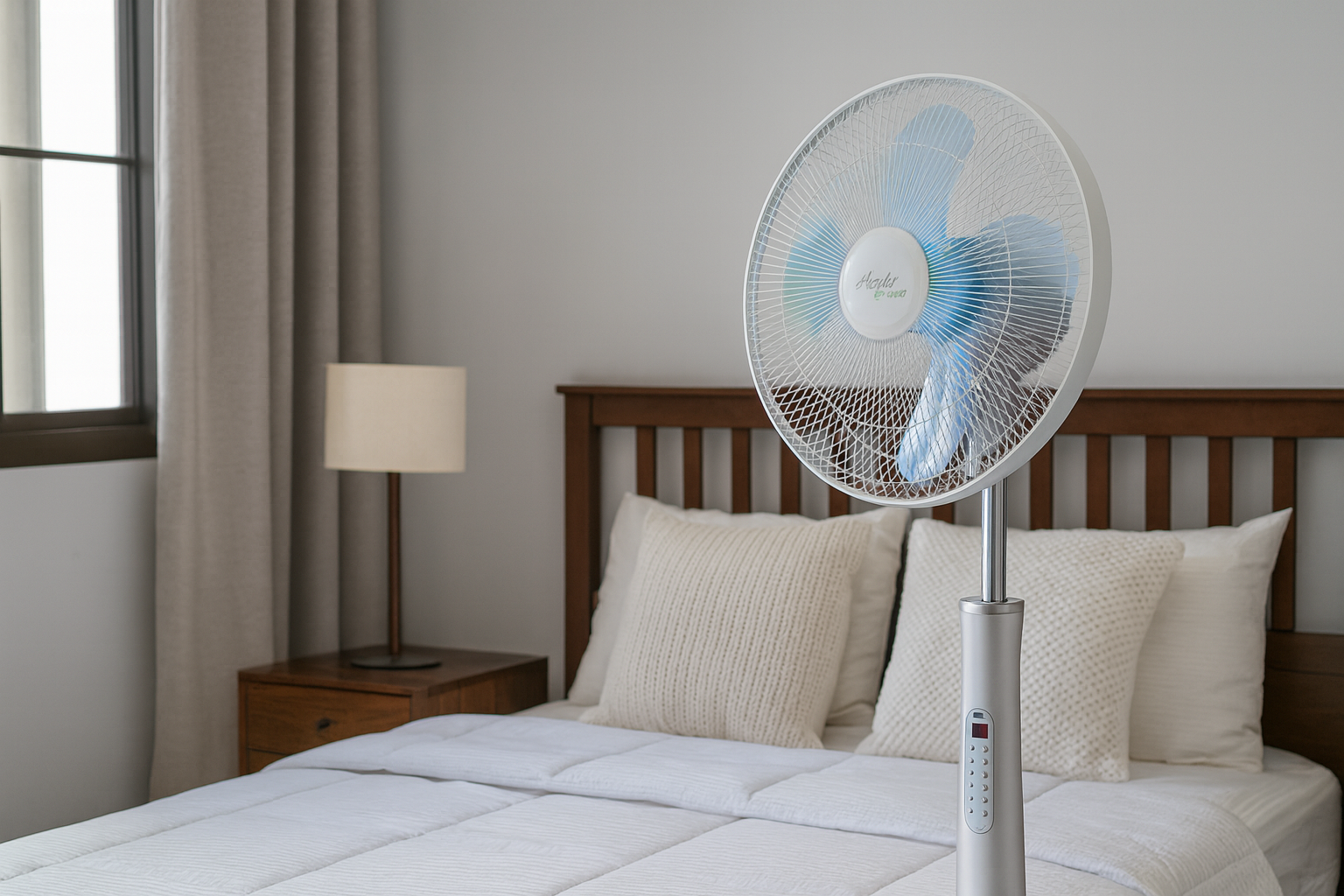
My Asahi DC 6072 DC Inverter Stand Fan (₱7,265 SRP)
- Power: 24 W
- Blade: 16″ (405 mm) 5-leaf AS plastic
- Speed Settings: 24
- Max Speed: 990 RPM
- Airflow: 58.4 m³/min
- Timer: 15 hours
- Extras: Remote control, oscillation, AI, LED display, quiet operation
This is not cheap at ₱7,265. But to a regular mom, a 24 W rating means this fan uses roughly the same power as one LED bulb—while your old AC fan might draw triple that. It’s quiet, has a wide range of speed settings, and the airflow is surprisingly strong for its wattage.
I like that when you turn it off and on again, it remembers the previous settings—no need to reset the speed or oscillation.
The only feature I don’t use is the “AI” mode, which turns off when the room temperature reaches 15 °C, a temp not likely possible where I live. But everything else works flawlessly.

My Asahi WF 630R DC Inverter Wall Fan (₱3,850 SRP)
- Power: 35 W
- Blade: 16″ (405 mm) 3-leaf banana blade
- Speed Settings: 6
- Max Speed: 1,406 RPM
- Airflow: 62.26 m³/min
- Timer: 1 h, 2 h, 4 h, 8 h
- Extras: Remote, tilt adjustment, thermal cut-off fuse, energy-efficient design
This one sits in my kitchen near a door that opens outside and half-open windows. The air circulation feels refreshing because it pushes air in and out efficiently. I love the timer—I always forget to turn off the kitchen fan, so this is a small but life-saving feature.
It’s also pricey at ₱3,850, but just think of the energy you save.

Final Thoughts
After months of switching fan by fan, I can say the DC inverter fans are worth it. They’re quiet, powerful, energy-efficient, and built to last.
Our electricity bill has noticeably gone down since I started replacing our old fans—and while I also upgraded our air conditioners to dual inverter models, I know the fans definitely contributed. It’s one of those small, consistent savings that quietly add up every month.
They may cost more upfront, but they pay for themselves through lower electric bills—and honestly, peace of mind.
I only have one fan left to replace, and whether I wait for the wall fan to restock or grab another stand fan, one thing’s for sure: I’m never going back to AC fans.
